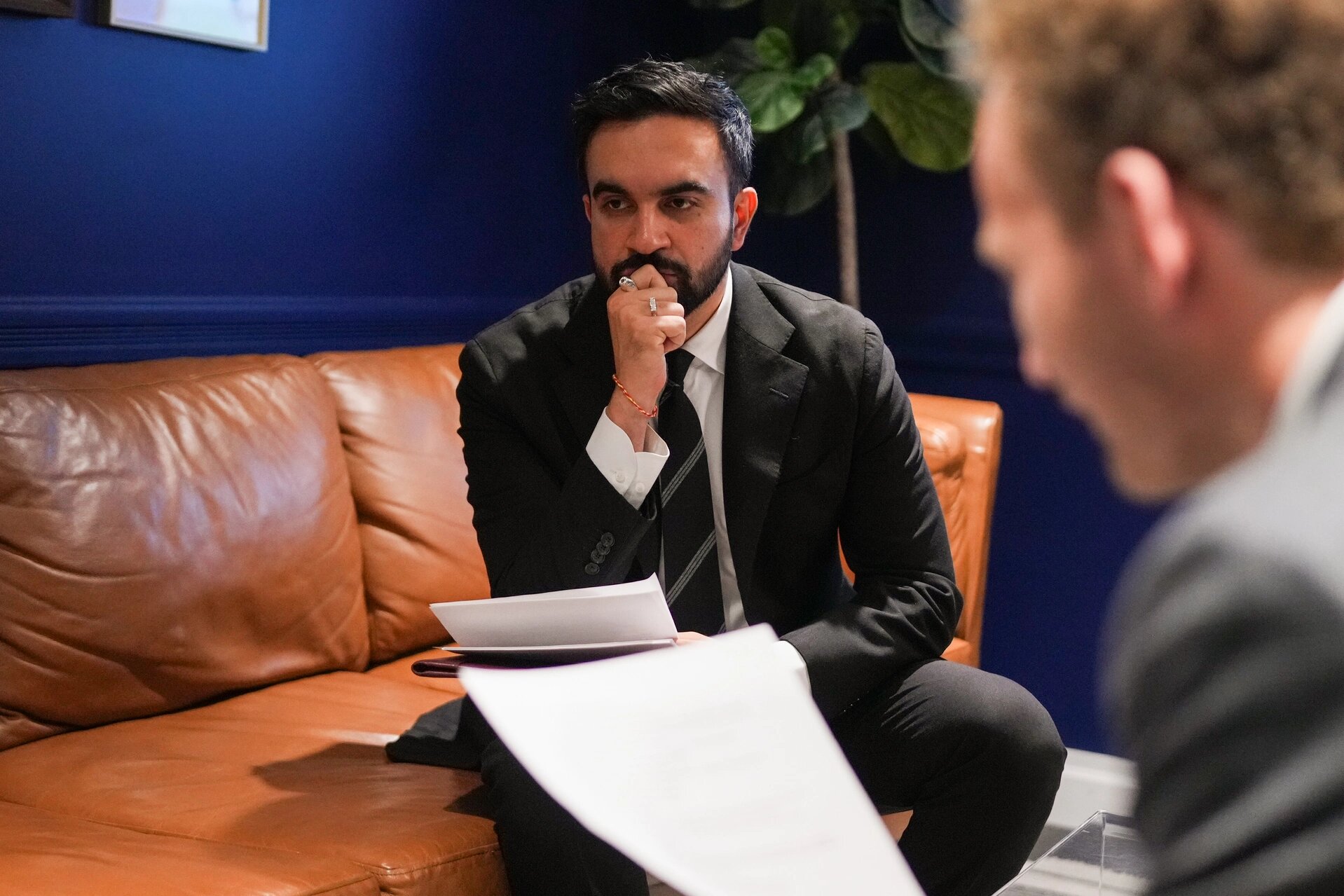
The president has threatened to yank federal aid and send the National Guard to patrol the Big Apple.
NEW YORK — President Donald Trump has all the power in his Oval Office sit down Friday with New York City mayor-elect Zohran Mamdani. And his advantage over the incoming mayor is vast.
The temperamental president has vowed to cut New York’s federal aid and may deploy the National Guard in response to Mamdani’s win. Trump’s border czar Tom Homan is again threatening to flood the city’s streets with immigration enforcement officers and conduct mass deportations. The president’s Congressional allies have pressed for the Ugandan-born mayor-elect’s citizenship to be revoked.
“The city or the state cannot do without the federal government and the federal government holds the money,” said John Catsimatidis, a billionaire oil executive and grocery store tycoon who speaks frequently with Trump. “Look, the president is going to do whatever he wants to do. He loves New York, no if’s, and’s about it. He loves New York, but he doesn’t love that the socialists are taking over New York.”
The much-anticipated meeting between the two diametrically opposed leaders will set the tone for the city’s future for the next four years. It contains a broader significance for Trump, who has sought to control the political destiny of deep blue cities while Democrats try to claw back into national power. He’s feuded with Democratic mayors in Chicago, Washington and Los Angeles — fights that New York officials desperately want to avoid. For Mamdani, whose far-left candidacy deeply divided his party, Trump presents a difficult and likely ongoing dilemma. The mayor-elect can’t afford Trump punishing the city or having his power clipped over the next four years. But appeasing him — or appearing to cow to him — will not be well-received by the supporters who propelled him into City Hall.
Mamdani is in the hotseat to prove that he can lead a deeply complex city. The first test is contending with its most powerful native son.
Nervous Democrats in the city and skeptical business leaders are closely watching the meeting as an early determination of whether the 34-year-old backbench state assemblymember can forge a working relationship with the mercurial Trump. They want to ensure that key construction efforts — like the Gateway tunnel between New York and New Jersey, the Second Avenue subway line and an overhaul of Penn Station — will continue with federal support.
Empire State Republicans have raised their concerns about Mamdani directly to Trump. Catsimatidis suggested to the president the federal government take over the city’s finances if the Mamdani administration is fiscally irresponsible. Rep. Nicole Malliotakis, the sole Republican House lawmaker from New York City, spoke with the president at Mar-a-Lago last week about the implications of the democratic socialist leading the city, she said in an interview.
State officials fear Trump will seize on Mamdani’s past support for slashing police budgets and send federal troops to the Big Apple, as he has done in other cities around the country.
The Republican president has already shown signs of tweaking the mayor-elect. A Wednesday night Truth Social post announcing the meeting included Mamdani’s middle name Kwame in quotations. “Communist Mayor of New York City, Zohran ‘Kwame’ Mamdani, has asked for a meeting,” he wrote.
Homan — whose appearance in Albany earlier this year turned into a viral protest staged by Mamdani and other Democrats — said Tuesday that the Immigration and Customs Enforcement agency would ramp up New York City operations. A mass deportation effort would create a politically fraught moment for Democrats, who have protested Trump’s aggressive strategy.
Trump may apply pressure in other ways. Inviting Israel Prime Minister Benjamin Netanyahu to New York City is one — virtually daring the new mayor to make good on his promise to issue an arrest warrant for the foreign head of state. If Mamdani follows through, he’d be entering fraught legal terrain. If he doesn’t, he’d risk inflaming a not insignificant portion of his base.
The meeting between Trump and Mamdani is a potential lesson in power politics for the incoming mayor, who wasn’t a blip on the political radar a year ago and has never managed a sprawling bureaucracy like New York City’s government, which employs some 300,000 people. On top of it all, Mamdani will be face-to-face with the world’s most powerful person, who has vowed to use the weight of the federal government as a cudgel against the city the mayor-elect is poised to lead starting Jan. 1.
This is Mamdani’s first real foray into the national political maelstrom. In the wake of his upset Democratic primary victory in June, he’s received support from Democratic luminaries like Sen. Bernie Sanders, former President Barack Obama and party stalwart Patrick Gaspard, a former U.S. ambassador.
“President Trump is willing to meet with anyone and talk to anyone and to try to do what’s right on behalf of the American people, whether they live in blue states or red states, or blue cities,” White House Press Secretary Karoline Leavitt said.
Mamdani, who directly challenged the president in his election night speech, expressed confidence about the meeting, as he was peppered with questions at a press availability Thursday.
“Being a New Yorker means that you’re prepared for all situations, all kind of comments, all kind of commentary,” he said. “At the end of it, the focus has to be, what’s the case that you’re making? Why are you there?”
Mamdani repeatedly said he wanted to talk to Trump about making the city more affordable — and even pivoted to the cost of living when asked if he’d push the president to keep ICE agents out of the city. His campaign’s core affordability message, he said, was “based on a value of protecting each and every New Yorker. That means protecting them from price gouging in their lives. It also means protecting them from ICE agents.”
The president, despite his public antagonism of the mayor-elect, is also open to a conversation, according to a White House official who was granted anonymity to describe Trump’s thinking.
“I think he’s going into it with a ‘I’m willing to talk to anyone, let’s see what this communist has to say,’” the official said. “I know he doesn’t expect to agree with what Mamdani says, but I think the president, again, Mamdani said he wanted to meet with him, and voila, here we are.”
Trump and Mamdani represent two immensely different versions of the same city.
The president, a magnate steeped in Gotham’s sharp-elbowed real estate world, grew his family’s business empire in the 1980s, a gilded era known for wealthy excess, expansive construction projects and a near-limitless appetite for success. New York in that time, too, was marked by deep poverty, crime and the crack epidemic.
Mamdani, elected with a coalition that includes the city’s growing South Asian population, is part of New York’s transplant community. A democratic socialist born into a well-to-do family, the city’s next mayor harnessed the swelling discontent of younger New Yorkers who have found it difficult to live in a costly city.
Yet both men can claim electoral victories that were powered by focusing on the cost of living. Their campaigns were deeply fluent in social media argot, using an authenticity that grew the ranks of their ardent supporters.
“They both cut their teeth in Queens and New York City,” said David Carlucci, a New York consultant and former state senator. “There’s a lot of common language that they can speak both understanding their political agenda. It’s so transparent, it’s so obvious that neither of them can have their bases believe they can work together or have a working relationship.”
Trump meddled repeatedly in the mayoral race this year — all in service of preventing a Mamdani victory. It also underscored a deep interest in who will lead his native city.
Trump dismissed Republican candidate Curtis Sliwa as a lightweight and referred to Mamdani as “my liddle communist.” The commentary was preceded by an unprecedented incursion by the president into the city’s political affairs.
In his first 100 days, Trump moved to end a controversial Manhattan toll program. His Department of Justice dropped a corruption case against Mayor Eric Adams, a moderate Democrat who cozied up to the president. Trump’s team dangled jobs in front of Adams in a bid to get him to drop his reelection campaign and aid the chances of former Gov. Andrew Cuomo, who lost the Democratic primary and his independent general election bid to Mamdani.
During the federal government shutdown, the Trump administration also yanked federal aid for the Gateway Tunnel and Second Avenue subway in an effort to pressure Democratic leaders Hakeem Jeffries and Chuck Schumer to cut a deal.
All of those actions were demonstrations of Trump’s power in a city that electorally rejected him three times.
“We’re not going to fund a socialist-communist agenda,” said Malliotakis, who represents Staten Island, the city’s most conservative borough. “We’re not going to allow this mayor to use federal funding to takeover supermarkets or legalize prostitution or seize the means of production or buy private property to turn them into communes. It’s making sure we protect taxpayers and make sure citizens get what they need.”
Mamdani wants the meeting to focus on affordability — the buzzy issue he campaigned on and which Trump rode to success last year, but is currently struggling with. Both men espouse economically populist ideas from polar ends of the political spectrum.
“I have many disagreements with the president, and I believe that we should be relentless and pursue all avenues and all meetings that can make our city affordable for every single New Yorker,” Mamdani told reporters Thursday. “I intend to make it clear to President Trump that I will work with him on any agenda that benefits New Yorkers. If an agenda hurts New Yorkers, I will also be the first to say so.”
Business leaders and prominent Democrats like Gov. Kathy Hochul believe Trump will keep his most aggressive impulses at bay given the president’s financial interests in the city. New York City’s Police Commissioner Jessica Tisch agreed to stay on in Mamdani’s administration — a development cheered by private sector leaders. There’s optimism that Trump wants New York to prosper. Whether that success is ultimately tied to Mamdani’s political fate is not clear.
“I’m convinced that the president is not going to stop projects because he likes development, he knows New York and he’s got a lot of friends here who are going to be part of these massive projects,” said Carlo Scissura, president of the New York Building Congress, a construction trade group. “That won’t stop the president from reminding the mayor-elect what his priorities are and what he wants done.”