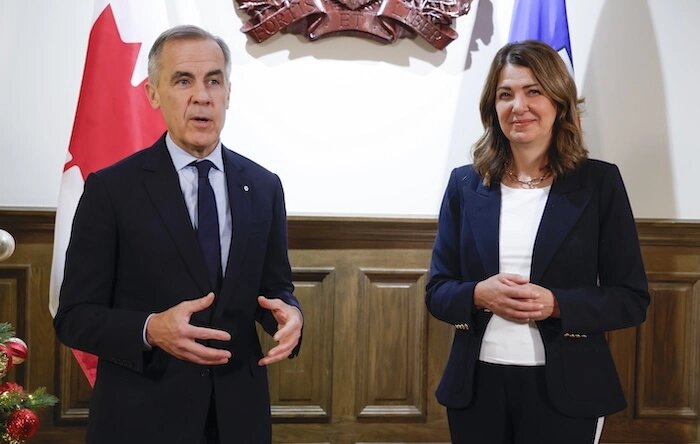
Ottawa pulls back from Trudeau-era climate policy in a landmark deal with Premier Danielle Smith.
Construction on a new pipeline to a British Columbia port could start as early as 2029 — with or without B.C.’s blessing — under a new plan negotiated by Ottawa and Alberta.
While the long-awaited memorandum of understanding between Ottawa and oil-rich Alberta contains environmental commitments such as reaching net-zero emissions by 2050 and developing nuclear energy, it clears the way for Alberta Premier Danielle Smith to get her long-sought oil pipeline built — despite the vociferous objections of her B.C. counterpart, David Eby.
“It’s the first step, I think, of what will be a few more steps we have to take together,” Smith told Prime Minister Mark Carney on Thursday in Calgary.
The MOU marks a landmark detente. Two traditionally oppositional governments are united in what they see as a “nation-building” effort to protect the Canadian economy from President Donald Trump’s economic threats.
“If that process goes appropriately … we should be able to say that shovels would be in the ground somewhere around 2029,” said an Alberta government official, speaking on the condition of anonymity per the terms of a joint briefing with Ottawa counterparts ahead of Smith and Carney’s signing ceremony.
The prime minister received a standing ovation from business leaders when he appeared on stage Thursday afternoon at an event hosted by the Calgary Chamber of Commerce. “Wow,” he said before acknowledging the western Canadian business audience as “a room that’s been held back but now ready to get things done.”
The five-page MOU sets a July 1 deadline for a pipeline proposal to be submitted to the Major Projects Office — the new entity Carney stood up earlier this year to fast-track “national interest” projects in response to Trump’s tariffs. The MOU says it would lead to the shipment of 300,000 to 400,000 additional barrels per day directly to Asian markets, bypassing the need to export through the United States.
The MOU attempts to untangle a decade of federal laws and regulations to entice reluctant investors to foot the bill for a new pipeline. Ottawa hopes to lure private capital back to Alberta because Carney’s government likely doesn’t have the political capital to do what its predecessors did in 2018: the Justin Trudeau Liberals paid C$4.5 billion for Canada’s only other oil pipeline that exports oil directly to Asian markets.
The Trans Mountain Pipeline Expansion’s costs soared to more than C$34 billion.
An Alberta official hinted Thursday at who might step up to build a pipeline. “We are working in collaboration with three of the best pipeline companies in Canada as part of standing up the application that will go forward to the Major Projects Office,” said the official, who declined to name the prospective builders.
But Carney made it clear Thursday: “If there’s not a private sector proponent, they’re won’t be a pipeline.” He added in French: “It’s not about federal government money or funding from Alberta.”
In British Columbia, Eby poured cold water on the prospect of an investor stepping up for an oil pipeline, while pointing out his province has billions of dollars worth of fully funded and shovel-ready LNG export projects.
“We need to make sure that this project doesn’t become an energy vampire with all of the variables that have yet to be fulfilled — no proponent, no route, no money, no First Nation support,” Eby said Thursday.
He also reiterated his opposition to lifting a 2018 federal ban on oil tankers off B.C.’s northern coast, saying an “oil spill would decimate a way of life of people in the northwest of our province.”
Thursday’s MOU and comments by officials claim a pipeline would be in the national interest, likely overriding any objections by B.C. They also make clear a series of steps involving cooperation and consultation between Alberta, B.C., and First Nations groups must be met before an eventual pipeline falls into place.
That includes “co-ownership” of the pipeline by Indigenous groups, says the MOU.
“At the heart of this is cooperation, partnership with Indigenous peoples in Alberta, in British Columbia, as they’re affected,” Carney said Thursday.
The MOU gives Alberta relief from other federal edicts that Smith and the oil industry have long opposed, and that analysts say has driven away private investment — a cap on oil and gas emissions, and the Clean Energy Regulations that require the province to drive down emissions from its electricity generation.
A federal official said that as much as the MOU is about a pipeline, it is also about Canada “meeting our climate objectives and being competitive in a global market. These are things we need to do before we get there, and this MOU lays out the groundwork for future collaboration with Alberta in the months ahead.”
That includes an agreement by both parties to achieve net-zero greenhouse gas emissions by 2050, and supporting “construction and financing” of the C$16.5 billion Pathways Alliance carbon capture and storage project to lower the carbon content of Alberta oil.
The MOU calls for the creation of “thousands of megawatts” of new electricity generation to power AI computing “with a large portion dedicated to sovereign cloud for Canada and its allies,” as well as the creation of “large transmission entities” to link Alberta’s electricity grid with its B.C. and Saskatchewan neighbors.
The deal also calls for Alberta and Ottawa to reach an agreement on industrial carbon pricing by April 1, 2026. It could raise Alberta’s current carbon price from C$95 per ton to $130 per ton. Alberta froze its carbon price at C$95 per ton in May, sparking criticism from environmental watchdogs that the lower rate would “reduce the likelihood of companies making investments in emissions reductions.”