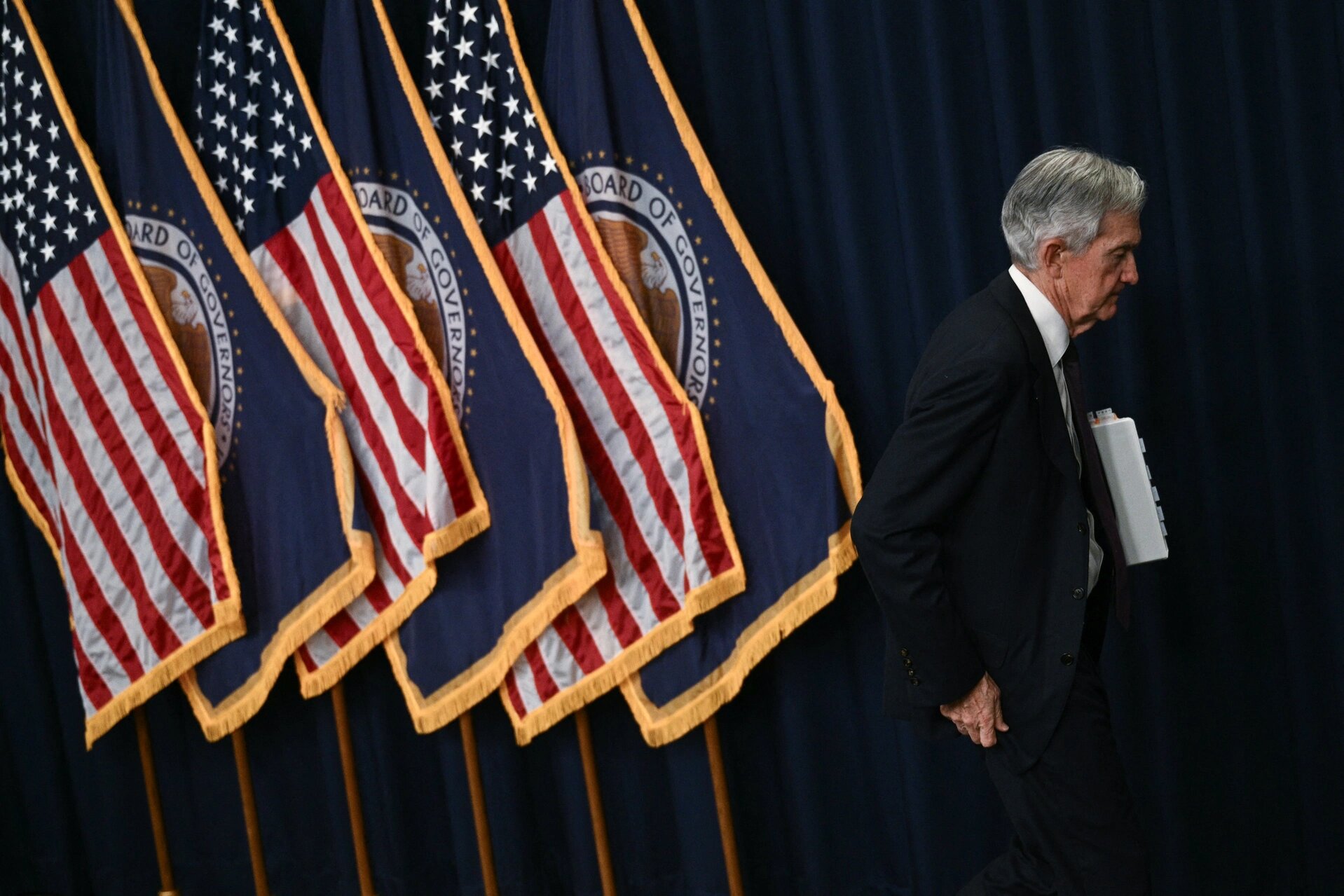
The president is under fire from Democrats for what they say is his failure to bring down prices, and polls show voters lack confidence in his economic leadership.
The Federal Reserve is poised to frustrate President Donald Trump. Again.
Central bank policymakers are increasingly split over whether they should lower interest rates in December, with investors now expecting the Fed to stand pat, a remarkable turnabout from just a few weeks ago when more than 90 percent were predicting a cut.
And even if the Fed decides to move forward with a reduction at its meeting next month, anxiety over lingering inflation is raising the chances that policymakers will take a longer pause than once anticipated in their campaign to lower rates. That’s ramping up tensions with Trump, who has relentlessly leaned on Fed Chair Jerome Powell to slash borrowing costs, even as the president this week declared that this is “the golden age” of America’s economy.
“Frankly, I would love to get the guy currently in there out right now, but people are holding me back,” the president said to reporters about Powell on Tuesday in the Oval Office.
“I’ll be honest, I’d love to fire his ass,” he said at an event on Wednesday.
Trump is under fire from Democrats for what they say is his failure to bring down consumer prices, and polls show voters lack confidence in his economic leadership. That has prompted the White House to place the issue of “affordability” at the top of its agenda and the president to tout a series of ideas, like rebates for Americans on import tariffs, to address the concern.
Yet Powell is far from the president’s only problem. A complicated economic picture is scrambling the outlook for Fed officials and dividing them on the path forward. Even if the central bank chief preferred lower borrowing costs, he’d still have to convince the rest of his policy-setting committee to go along — a rare challenge in a normally consensus-driven institution.
Recent developments have only added to the potential for disagreement.
There’s a huge hole in the intel that the Fed relies on to make its decisions, partly because the government shutdown stalled the collection of key data, but also because staff and budget cuts have impaired the statistical agencies. As a result of the shutdown, the Fed will not get fresh data on the jobs market until Dec. 16 — a week after its rate decision.
A landmark case before the Supreme Court could also potentially undo tens of billions of dollars in already collected tariffs, further muddying both the government’s fiscal situation and the business environment.
Meanwhile, there’s no clear narrative to glean from available economic data. Growth in the second quarter came in strong, fueled by consumer spending and investments in artificial intelligence, but the unemployment rate has been steadily ticking up. Tariffs are pushing up some prices on a range of goods, but not as much as feared. Hiring has slowed to a crawl, but layoffs have not accelerated.
The jobs report for September, released Thursday, doesn’t make those dynamics much clearer. Policymakers who prefer a rate cut can point to the rising jobless rate, which hit 4.4 percent that month, and those who prefer to hold steady can point to above-expected hiring, as businesses added 119,000 jobs.
So while dissension in the ranks is unusually high at the Fed, there are “clear reasons for a difference in views,” said Seth Carpenter, global chief economist at Morgan Stanley and a former senior staffer at the central bank. “Spending is strong. Employment is weak. That’s an unusual circumstance.”
In one of the worst-case scenarios for Fed officials, if they lower rates too much, it could lead to a new surge of inflation and ultimately call for rate increases — just as Trump’s new Fed chair is settling into office next year after Powell steps down from the post.
Treasury Secretary Scott Bessent, who is leading the Fed chair search, has said the shortlist consists of five candidates, including three who have been named publicly by Trump himself: White House economic adviser Kevin Hassett, Fed board member Christopher Waller and former Fed board member Kevin Warsh.
“The Fed should be concerned about setting its rate too low and potentially having to raise interest rates in the second half of 2026,” said Michael Strain, director of economic policy studies at the conservative American Enterprise Institute.
Strain argued that the Fed should not have cut at the last two rate-setting meetings either.
“To me, the labor market looks relatively solid,” he said. “Less strong than it looked two years ago, but two years ago, it looked unsustainably strong.”
Newly released minutes from the Fed’s October meeting showed that most of the rate-setting committee still expects to cut rates at some point, but there was disagreement as to how soon that should happen.
Vice Chair Philip Jefferson said in a speech this week that there are risks that unemployment could begin to rise more rapidly, but also that inflation might accelerate, a situation that he said calls for moving “slowly” to cut rates.
Meanwhile, Cleveland Fed President Beth Hammack, Dallas Fed President Lorie Logan and Minneapolis Fed President Neel Kashkari, none of whom have votes on rates this year on the policy-setting Federal Open Market Committee but will next year, all said they would have preferred not to reduce rates in October.
“I’d find it difficult to cut rates again in December unless there is clear evidence that inflation will fall faster than expected or that the labor market will cool more rapidly,” Logan said recently.