A majority of both Democrats and Republicans support redrawing congressional districts to give their side a boost next year.
Voters in both parties want to go on offense in the redistricting fight.
A new POLITICO Poll shows both Democrats and Republicans support redrawing congressional districts to give their side a boost in the midterms. And there is no apparent appetite for a ceasefire in the gerrymandering wars: Most voters on the left and right favor using partisan redistricting not just to level the playing field, but as a weapon to help them win.
Among voters who say they would vote for Democrats in the midterms, 54 percent say they support drawing maps to gain an advantage over Republicans in the midterms. A similar 53 percent of GOP voters agreed with gerrymandering to help their party, the survey of 2,098 U.S. adults found.
A majority of Americans support partisan map-drawing
Percentage of Americans who support redrawing congressional districts to neutralize the other party — and those who support doing so to gain a midterm advantage.
The shifting sentiment comes as both parties are locked in a bitter map-drawing arms race. The partisan tilt of the final map is still in flux, but neither party has slowed down since President Donald Trump first pushed Texas Republicans this summer to redraw their maps to benefit the GOP.
Republicans across the country have followed Trump’s lead — and blue-state Democrats have fired back with new maps of their own. Both sides have cast their escalating efforts as a necessary defense of democracy, designed to neutralize the other party’s map-drawing.
“We’ve seen an extraordinary public outcry in favor of fighting back against Donald Trump’s overreaches in basically every forum,” said John Bisognano, president of National Democratic Redistricting Committee.
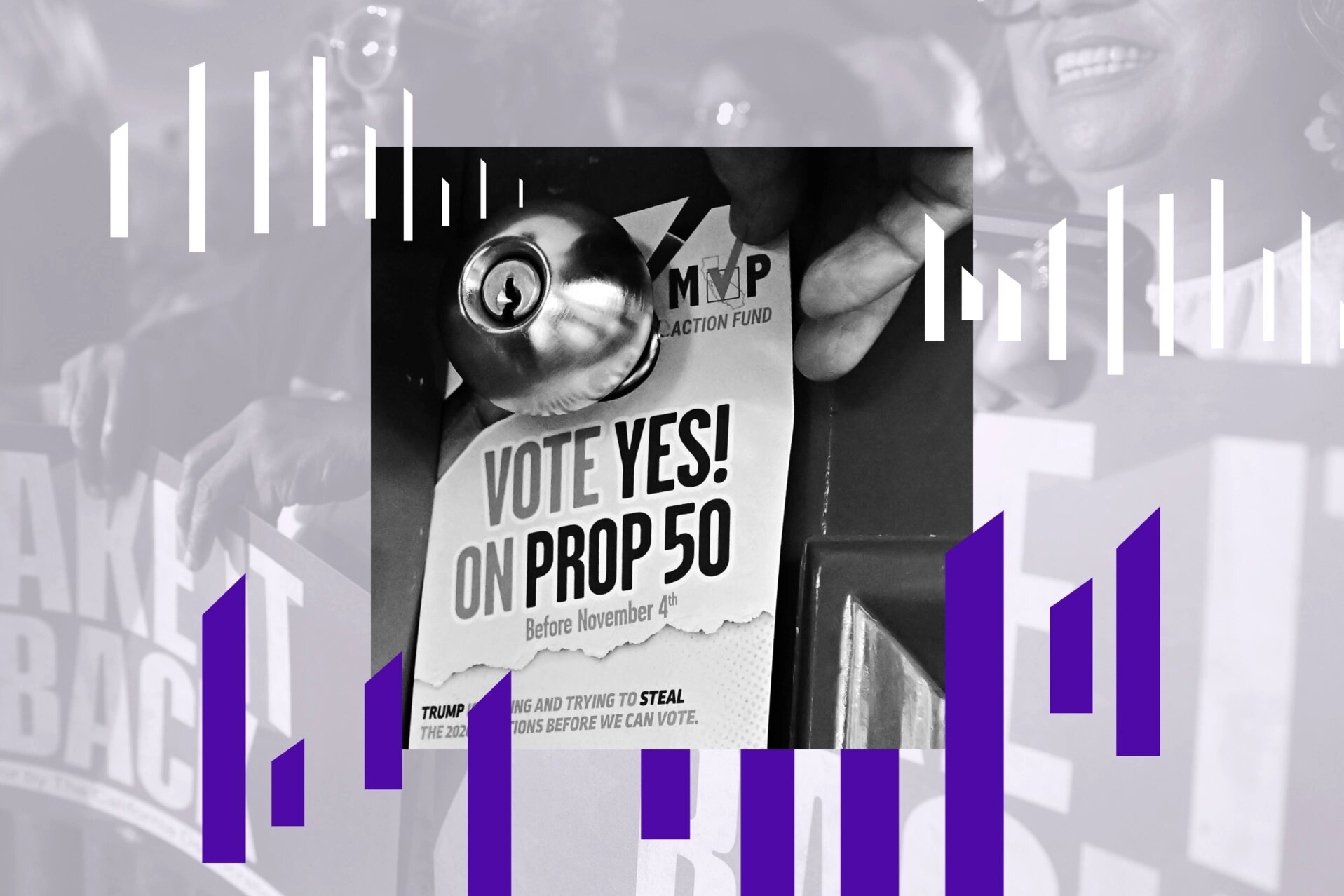
He pointed to the passage of Proposition 50 in California — which redrew the state’s congressional maps to advantage Democrats in five districts — as a sign of the “astronomical amount of energy and support” driving Democrats. Roughly seven million voters supported the proposition, which California Gov. Gavin Newsom explicitly cast as a response to the GOP effort to create five red-leaning districts in Texas.
The redistricting feud has since exploded into a cross-country battle involving more than a dozen states.
“Redistricting and its excesses are at the top of the agenda of most of the public,” said Kareem Crayton, vice president of the Washington office of the liberal-leaning advocacy group the Brennan Center for Justice. He said that in the past he’s had to “spend time” explaining redistricting, but “everybody now understands what the stakes are.”
The POLITICO Poll, conducted by Public First from Nov. 14 to 17, helps shed light on public opinion as the redistricting fight enters a new and uncertain stage.
While prominent voices in both parties increasingly view redistricting as the best way to lock in an edge ahead of next year’s midterms, they’ve also encountered resistance — both from lawmakers in their own ranks and the courts. The battle over who ultimately stands to win has become increasingly unclear.
Republicans have suffered serious setbacks this week alone. A panel of federal judges struck down the redrawn Texas map, throwing it into flux as the GOP appeals to the Supreme Court. And Indiana Republicans, repeatedly pressured by Trump and his allies to draw new maps, bucked him and punted the issue to January.
The court ruling gave Democrats, at least for now, a slight advantage in the redistricting war, following California’s Prop 50 and picking up one other seat in Utah. They could pick up two more seats next year if Virginia moves forward with its redraw plan, which would need to be approved by voters.
That’s even as Missouri and North Carolina both passed maps that give Republicans one red-leaning seat each, while Ohio approved a map that makes two Democratic seats redder (though lawmakers there were required to redraw under state law). A handful of other states, including blue Maryland and red Florida, could soon join the fray, but both have been met by at least some resistance in the state legislatures.
Democrats, historically the party aligning itself with “good-government” reforms such as opposition to partisan gerrymandering, have made a sharp U-turn on redistricting this year as Trump and Republicans push the bounds of mid-cycle map-drawing.
It’s unclear what the long-term implications of the current redistricting battle are — including whether it will undo years of efforts from good-government activists to ban partisan gerrymandering.
Bisognano said that voters’ partisan appetites may be a temporary response to Trump’s pre-midterms redistricting push.
Public opinion right now is split, The POLITICO Poll found. When given a choice, a 38 percent plurality of Americans supported drawing political maps through an independent, politically neutral process. Voters who supported former Vice President Kamala Harris were somewhat more likely to hold this view (47 percent) compared to Trump voters (39 percent).
Thirty-four percent of voters say political maps should be drawn by state legislatures but approved by voters. Seven percent say they should be drawn by state legislatures without approval by voters, while 21 percent say they are unsure.
“The vast majority of voters, when presented with … options related to Congress acting to stop this, mandating independent process nationwide, banning partisan gerrymandering nationwide, I put my money on the support for reform, any day of the week,” said Dan Vicuña, senior policy director of voting and fair representation at the liberal-leaning good-government group Common Cause. Common Cause has historically opposed gerrymandering and partisan redistricting, although the group softened its stance on redistricting amid California’s Prop 50 effort.
Reform may still be well off. For now, the bigger question remains whether this week’s court setbacks for Republicans — or voters’ growing comfort with partisan map-drawing — will prove short-lived or mark the beginning of a lasting shift.
When a random sample of the poll’s respondents were asked how Democrats should respond to Republican gerrymandering, less than a quarter — 21 percent — said Democrats should only challenge it in the courts. Twenty-nine percent said Democrats should gerrymander to neutralize the GOP — while 19 percent supported drawing maps to get an advantage.
The pattern also held across partisan lines: In response to a Democratic gerrymander, 20 percent of respondents said Republicans should take it to the courts, 30 percent said they should redraw maps to neutralize the impact and 16 percent said they should gerrymander to get an advantage.